Monroe Doctrine Desk:
Audio Transcription
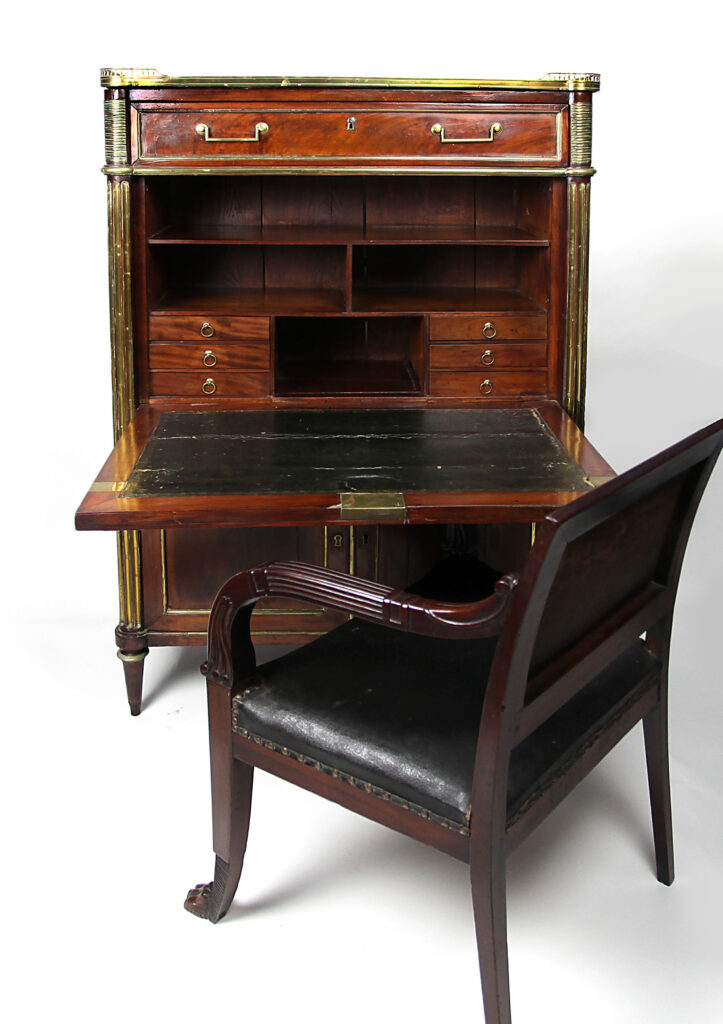
One of the most impactful aspects of Monroe’s presidency is his Monroe Doctrine, which stated that European affairs in the Western Hemisphere would be seen as a hostile action against the United States. This doctrine, a part of Monroe’s message to Congress in 1823, would become synonymous with the president due to the lasting impact it has had on American history, whereby the United States practiced a form of pseudo-isolationism from colonial powers in Europe for several decades. The desk on display is rumored to be where Monroe penned this pivotal document.
James Monroe And Slavery:
Audio Transcription
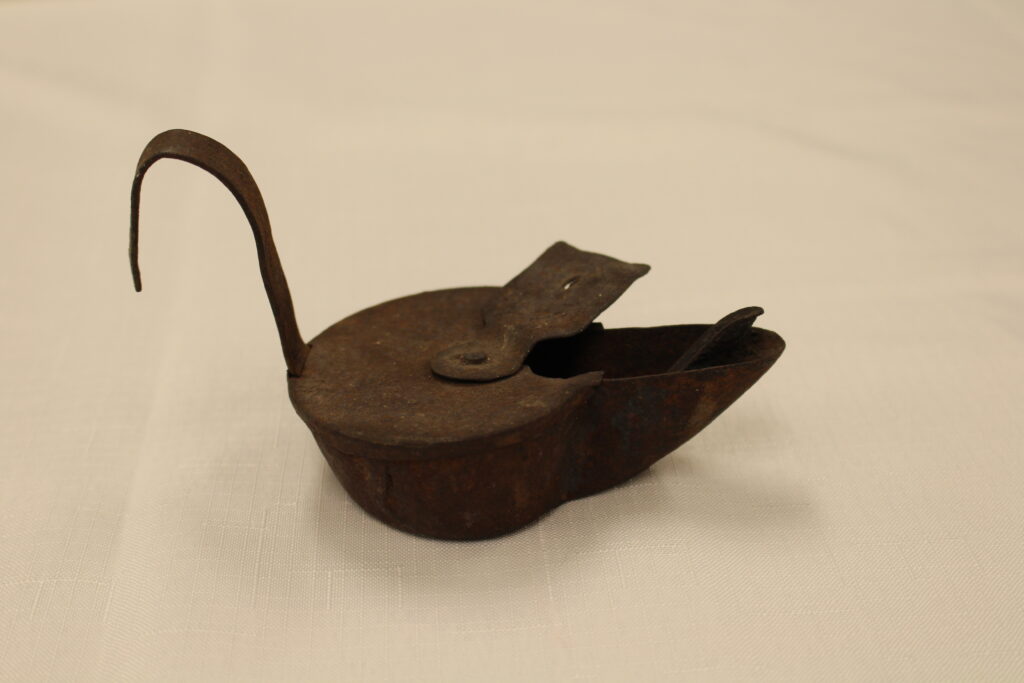
One of the defining issues of the Antebellum Era was the sectional crisis of slavery, and Monroe was one of the key figures in slavery politics in the early 19th century. It is important to note that Monroe himself utilized around 250 enslaved peoples to sustain his farms and households, and he frequently bought/sold them as well. One item on display is a Betty Lamp, a utilitarian lighting device mostly used by slaves, and it was made by an enslaved blacksmith at James Monroe’s residence. When acting as governor of Virginia, Monroe dealt with Gabriel’s Conspiracy, where an enslaved person named Gabriel tried to organize an uprising that would involve killing their masters and storming Richmond. Upon being tipped off by a farmer, Mosby Sheppard, in late August of 1800, Monroe immediately sent militia men to arrest the collaborators, halting what was shaping up to be one of the largest attempted slave revolts in U.S. history.
In the aftermath of Gabriel’s Conspiracy, Monroe moved to increase security measures in Richmond, ordering construction of a wall surrounding the prison, and assigning militia patrols in Richmond. This event changed the way Monroe thought about slavery and caused him to think more logistically about emancipation. The emancipation measure Monroe became involved with was the American Colonization Society (ACS), where enslaved peoples would be moved to Africa to live freely. Monroe thought that centuries of systemic racism would prevent emancipated slaves from getting equal rights in the United States, and opted to support efforts of colonization. These efforts were not fully realized until Monroe’s presidency, where he passed legislation to enable U.S. Navy ships to seize slave transports and return them to Africa.
The most prominent piece of legislation that Monroe was involved with during his presidency was the Missouri Compromise. Debates broke out about whether Missouri should enter the union as a free state or a slave state, which had huge ramifications for the Congressional majority. Monroe worked behind the scenes to draft a compromise to admit Missouri as a slave state, and Maine as a free state, to keep the balance. Crucially, the stipulation was added that no new states above the 36th parallel could be slave states, and the sectional issue grappling the country was temporarily dealt with. Debates around slavery reinforced Monroe’s belief that the presence of slaves and black citizens had the potential to break the union apart, a sentiment that would come fully realized just 41 years later with the outbreak of the Civil War.
Refurbishing Of The White House:
Audio Transcription
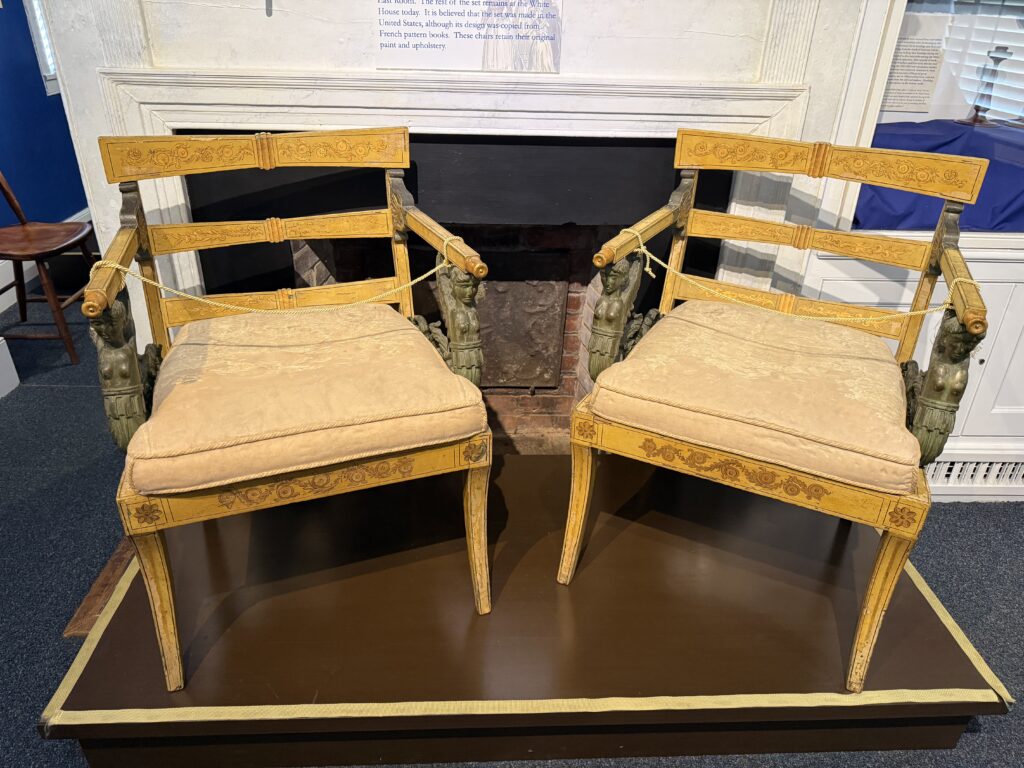
Featured around the Era of Good Feeling room are several period-appropriate armchairs, including a pair of Neoclassical Armchairs known to be purchased by the Monroes. The emphasis on furniture is due to the fact that Monroe was largely responsible for the refurnishing of the White House after the British burned it down during the War of 1812. Many of the decisions that Monroe made have had lasting impacts to the look of the White House interior to the Modern day, including the emphasis of foreign designs to elicit feelings of prestige.
Elizabeth Monroe:
Audio Transcription
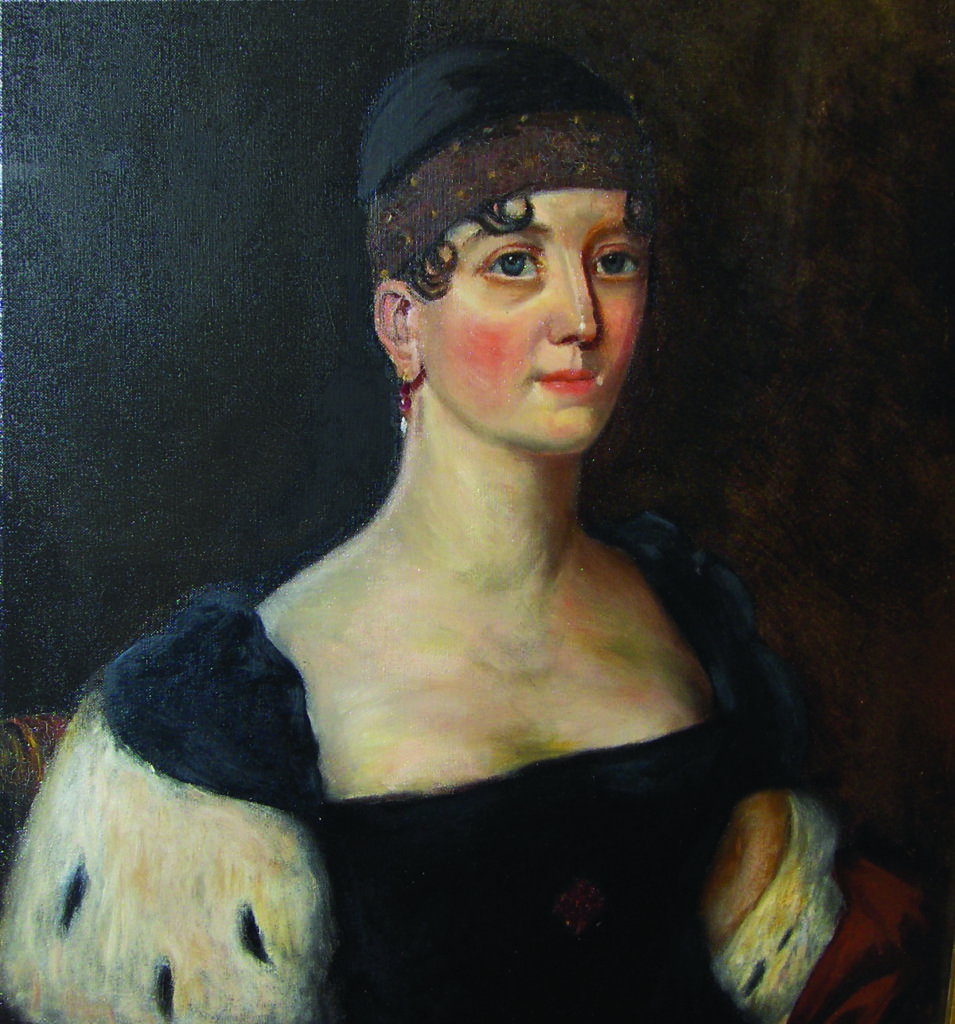
Painting of Elizabeth Kortright Monroe. Oil on canvas, circa 1910. Painted by Frances Maury Burke, an imitation after John Vanderlyn. Frances “Fanny” Maury Burke, born 1861 died 1933, painted this likeness of Elizabeth Monroe in imitation of a circa 1803 portrait by John Vanderlyn that hangs in the White House. Burke was the 3rd great-granddaughter of Thomas Jefferson. Elizabeth Monroe, born Kortright was born on June 30th, 1768, in New York City to Captain Lawrence Kortright and Hannah Aspinwall Kortright. Captain Kortright was a wealthy merchant, and his daughters were fixtures of the New York social world. In 1785, James Monroe would meet 16 year old Elizabeth while in New York and immediately fell in love with the beautiful young woman. They were married on February 16th, 1786 at Trinity Episcopal Church in Manhattan. Within their first year of marriage, Mrs. Monroe gave birth to their first child – a daughter whom they named Elizabeth. In May of 1799, Mrs. Monroe had her second child, named James Spence. The baby boy died the following September, never fully gaining sound health. Their last child, Maria Hester, was born in April of 1802. Elizabeth Monroe followed her husband through their series of homes and elected positions for 45 years. Throughout their marriage, she was responsible for maintaining the image and public persona that her husband’s career demanded. She was considered at the height of sophistication in both her style of dress and in her skills as a hostess. The French patrons at Napoleon’s court referred to her as “la belle Americaine” (the beautiful American). For most of her married life, Elizabeth Monroe was plagued by an unidentifiable illness, often mentioned in her husband’s correspondence. Although it is not known what her illness was, we do know that it may have eventually contributed to her death. Mrs. Monroe was confined to bed for a long period of time in 1830, and the Monroes’ physician finally suggested a series of blood-lettings to rid her body of toxins. These bleedings left her weak, and on September 23rd she finally succumbed. Her husband was devastated, and took the extreme step of burning all of the correspondence written between him and his beloved wife during their life together. Sadly, this act of grief has deprived us of knowing Elizabeth Monroe’s personal thoughts and opinions – all we know of her today is from what others have written about her. Elizabeth Monroe was buried in the family vault at Oak Hill, and later in the 19th century she and her daughter Maria were exhumed for removal to Hollywood Cemetery to be laid next to the remains of James Monroe.
Monroe’s Pianoforte:
Audio Transcription
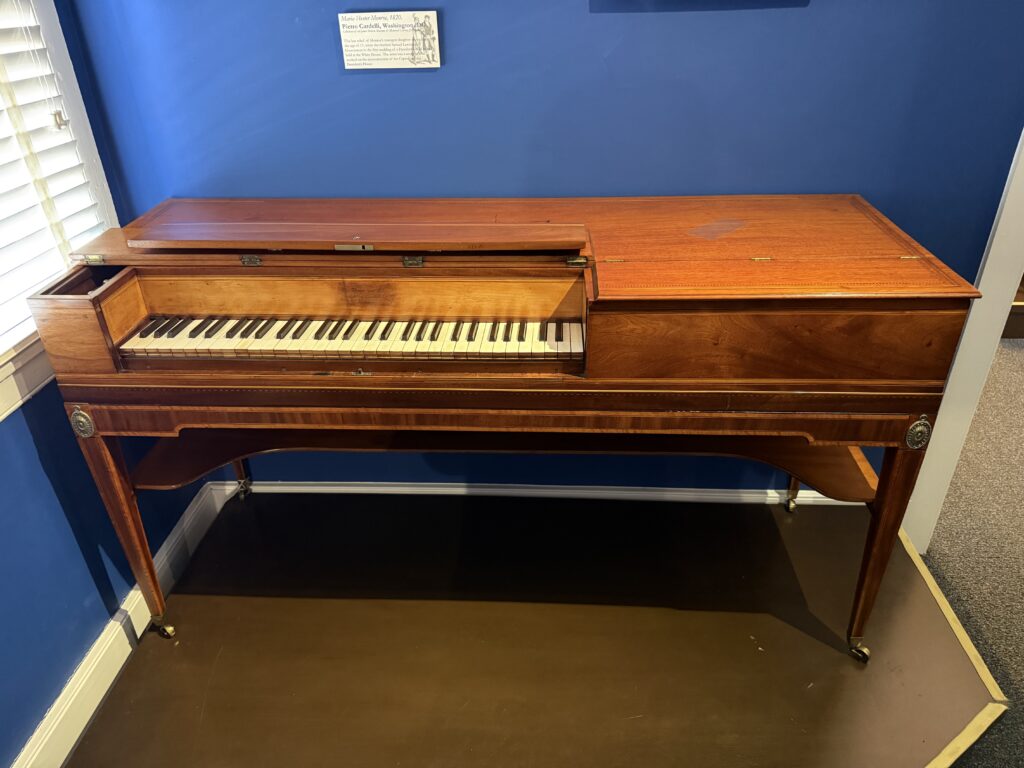
This piano forte, owned by the Monroe family, is estimated to be from 1790. The square pianoforte was purchased by Monroe while in the role of Ambassador to England. This pianoforte may have also been used by the family in the President’s house. It was often played by both Elizabeth Monroe and her daughter Maria Hester. The piano forte still works to this day! To maintain the sound of the piano forte it needs to be played regularly. The conservation of the piano forte is funded by the Monroe Randall Hoes Memorial Fund for Artifact Conservation, the Sunshine Lady Foundation and the Friends of the James Monroe Museum.
Monroe’s Pistols:
Audio Transcription
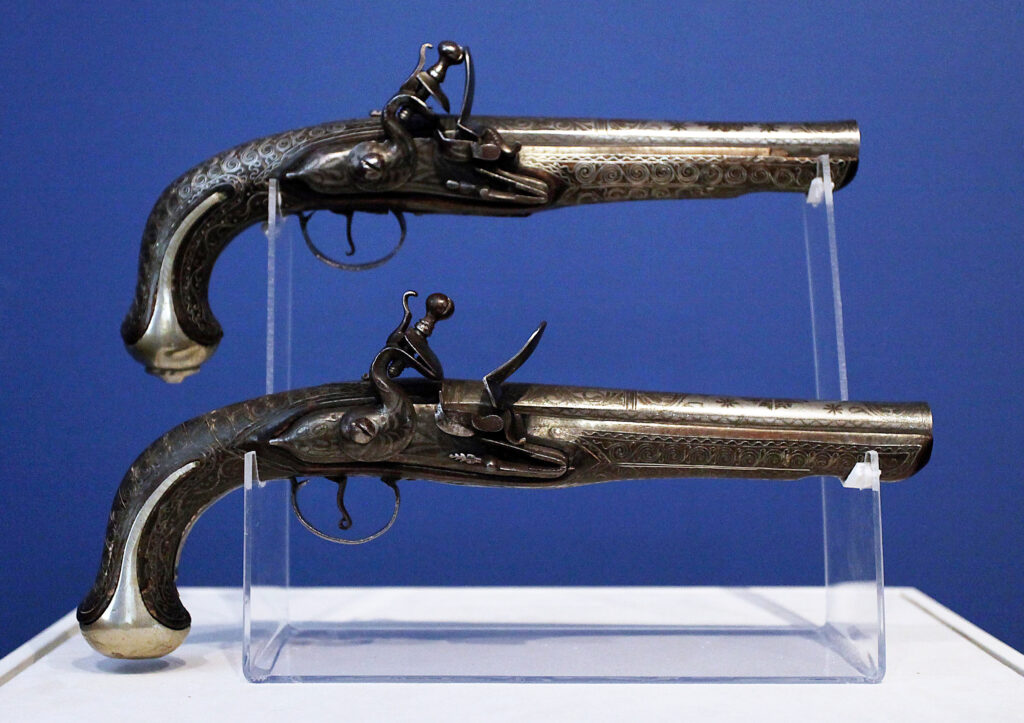
Pair of Pistols:
Circa 1815 – 1816, United Provinces of the Rio de la Plaza (later to become Argentina).
Constructed of forged iron and wood, and featuring intricate nickel-silver inlay, the origin of this pair of flintlock pistols is an intriguing mystery.
Passed down through Monroe family, these pistols were donated by the museum’s founding director and direct descendent Laurence Gouverneur Hoes. According to Mr. Hoes, family tradition stated that the pistols were a gift to James Monroe from the government of Argentina with some unusual properties. In a 1962 letter he wrote:
“The story always passed down in my family in that the pistols were made in Argentina and the iron and steel was made from some special and unusual ore.”
Here is where the story takes an interesting turn. In the summer 1962, Mr. Hoes received a phone call from the National Archives informing him of an 1816 presentation of pistols to President James Madison by General Ignacio Alvarez, Supreme Director of the United Provenances of the Rio de la Plata (soon to become Argentina). The pistols described in the presentation were from the “first essays of the Manufacture of arms” large meteoric iron deposit known as “Campo del Cielo.” Knowing the family history of the museum’s pistols were the same ones presented to Madison by General Alvarez and later gifted to Monroe. Indeed, given the evidence at the time this seemed a reasonable conclusion and the story of the pistols remained as such… until 2006.
In 2006 the pistols were sent to the ISIS neutron source in Oxfordshire, UK, where they were compared to known samples from the Campo del Cielo meteor deposit, Tests proved conclusively that the pistols were not made from the meteoric iron. Further, the tests also showed that the inlay was not silver as previously thought, but nickel silver. This suggests a number of scenarios. The pistols could have been made by the armory in Buenos Aires as General Alvarez claimed, but simply not made with meteoric iron. However, if this is true, why would the leader of a recently independent country present to Madison pistols with inlay of nickel silver rather than real silver, especially if her were trying to garner favor with the United States? On the other hand, the family history of the pistols as a gift from the government of Argentina and “made from special and unusual ore” is compelling, even if the pistols were made in Buenos Aires but not with meteoric iron. Many of the arms there were made with meteoric iron and could have been assumed the pistols were made with the same material.
Not withstanding this uncertainty, the pistols were indeed passed down through the Monroe family, and there is no reason to doubt they belonged to James Monroe. Whether they were the pistols gifted to James Madison who in turn gifted them to James Monroe remains and intriguing and unsolved mystery.
Oak Board:
Audio Transcription
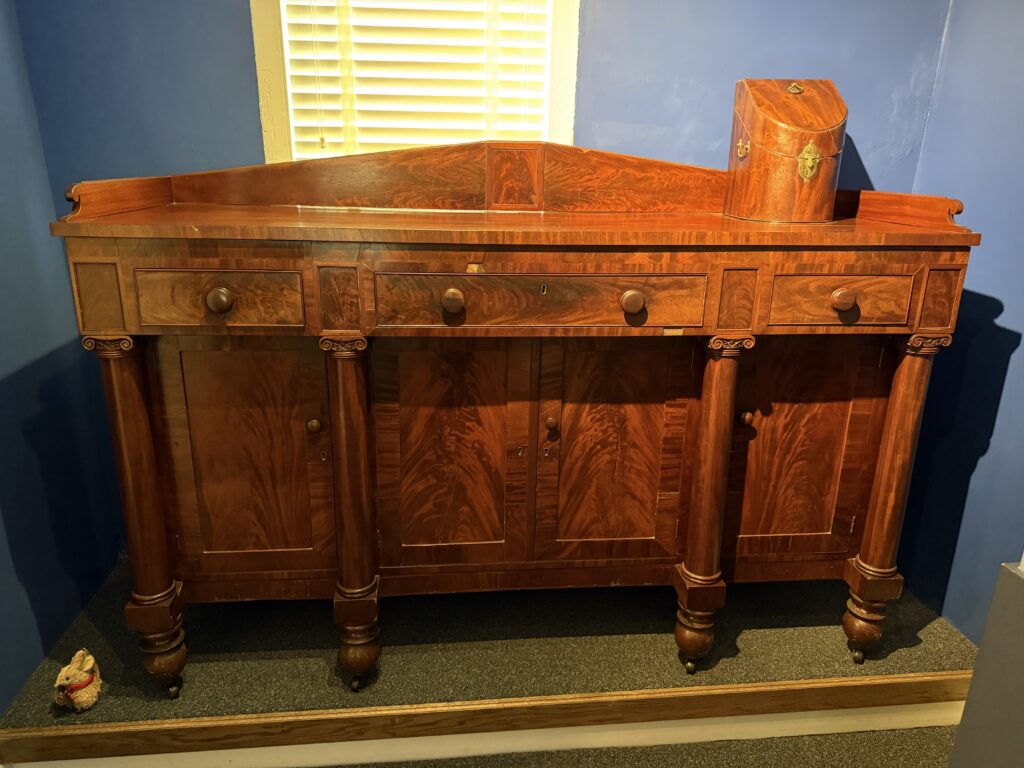
James Monroe’s Sideboard and the Empire Style. Donated by Mr. Aldrich Dudley in 1981, The sideboard is a magnificent example of American Empire-style craftsmanship. Attributed to Baltimore furniture maker John Needles, the sideboard features a dazzling “flame” mahogany veneer, a pitched back rail pediment, Ionic columns, and decorative scrollwork. The sideboard came into Mr Dudley’s possession passed down from his father who had purchased it in 1926 from Joseph Redd, who had acquired it from Jonah Hood, who is thought to have originally purchased the sideboard between 1830 and 1860 from Oak Hill.